By The People

There are fundamental flaws in how American government operates today,
contrary to the Constitution and the vision of a representative republican form of governance.
I intend doing something about it: by educating and informing others who
are not even aware of the dangers.

Showing posts with label US society. American values. Show all posts

Wednesday, February 12, 2014

Two Americas Tied in a Bow


"In early January 2014, Bob Lonsberry, a Rochester talk radio personality on WHAM 1180 AM, read his 'Two Americas' response to Barry Soetoro's/Obama speech on 'Income inequality'":

Two Americas
by Bob Lonsberry,
December 9th, 2013

The Democrats are right, there are two Americas.

The America that works, and the America that doesn’t. The America that contributes, and the America that doesn’t. It’s not the haves and the have nots, it’s the dos and the don’ts. Some people do their duty as Americans, obey the law, support themselves, contribute to society, and others don’t. That’s the divide in America.

It’s not about income inequality, it’s about civic irresponsibility. It’s about a political party that preaches hatred, greed and victimization in order to win elective office. It’s about a political party that loves power more than it loves its country. That’s not invective, that’s truth, and it’s about time someone said it.

The politics of envy was on proud display a couple weeks ago when President Obama pledged the rest of his term to fighting “income inequality.” He noted that some people make more than other people, that some people have higher incomes than others, and he says that’s not just.

That is the rationale of thievery. The other guy has it, you want it, Obama will take it for you. Vote Democrat. That is the philosophy that produced Detroit. It is the electoral philosophy that is destroying America.

It conceals a fundamental deviation from American values and common sense because it ends up not benefiting the people who support it, but a betrayal. The Democrats have not empowered their followers, they have enslaved them in a culture of dependence and entitlement, of victimhood and anger instead of ability and hope.

The president’s premise – that you reduce income inequality by debasing the successful – seeks to deny the successful the consequences of their choices and spare the unsuccessful the consequences of their choices.

Because, by and large, income variations in society is a result of different choices leading to different consequences. Those who choose wisely and responsibility have a far greater likelihood of success, while those who choose foolishly and irresponsibly have a far greater likelihood of failure. Success and failure usually manifest themselves in personal and family income.

You choose to drop out of high school or to skip college - and you are apt to have a different outcome than someone who gets a diploma and pushes on with purposeful education. You have your children out of wedlock and life is apt to take one course; you have them within a marriage and life is apt to take another course. Most often in life our destination is determined by the course we take.

My doctor, for example, makes far more than I do. There is significant income inequality between us. Our lives have had an inequality of outcome, but, our lives also have had an inequality of effort. While my doctor went to college and then devoted his young adulthood to medical school and residency, I got a job in a restaurant.

He made a choice, I made a choice, and our choices led us to different outcomes. His outcome pays a lot better than mine.

Does that mean he cheated and Barack Obama needs to take away his wealth? No, it means we are both free men in a free society where free choices lead to different outcomes.

It is not inequality Barack Obama intends to take away, it is freedom. The freedom to succeed, and the freedom to fail. There is no true option for success if there is no true option for failure.

The pursuit of happiness means a whole lot less when you face the punitive hand of government if your pursuit brings you more happiness than the other guy. Even if the other guy sat on his arse and did nothing. Even if the other guy made a lifetime’s worth of asinine and shortsighted decisions.

Barack Obama and the Democrats preach equality of outcome as a right, while completely ignoring inequality of effort.

The simple Law of the Harvest – as ye sow, so shall ye reap – is sometimes applied as, “The harder you work, the more you get." Obama would turn that upside down. Those who achieve are to be punished as enemies of society and those who fail are to be rewarded as wards of society.

Entitlement will replace effort as the key to upward mobility in American society if Barack Obama gets his way. He seeks a lowest common denominator society in which the government besieges the successful and productive to foster equality through mediocrity.

He and his party speak of two Americas, and their grip on power is based on using the votes of one to sap the productivity of the other. America is not divided by the differences in our outcomes, it is divided by the differences in our efforts. It is a false philosophy to say one man’s success comes about unavoidably as the result of another man’s victimization.

What Obama offered was not a solution, but a separatism. He fomented division and strife, pitted one set of Americans against another for his own political benefit. That’s what socialists offer. Marxist class warfare wrapped up with a bow."


Income Inequality speech text from:  http://www.politico.com/story/2013/12/obama-income-inequality-100662.html#ixzz2too6EJSA  as provided by The White House

Monday, December 31, 2012

The Phony Drug War

If you have ever been arrested on drug charges and have had to endure incarceration for it, this story will certainly thrill you.

The British giant banking firm, HSBC, was slapped on the wrist this week by the United States Department of Justice and while they violated several laws (the Bank Secrecy Act and the Trading With The Enemy Act) no criminal charges will be filed. Instead Assistant Attorney General Lanny Breuer, the longtime buddy of none other than former President William Jefferson Clinton has chosen to settle with the banks for $1.9 billion dollars, despite the fact that HSBC makes more than that in less than a week of banking. While admitting they have laundered billions for both Colombian and Mexican drug cartels and others, the USDOJ will prosecute possession of drugs (don't get caught with a pot seed!) to the fullest extent of the law, while allowing the real pushers to get away with crimes.


This is evidence that there is no real war on drugs, only a war on individuals who choose to exercise their own choice to use drugs. While in many cases, the choice is a poor one, you cannot deny the fact that prosecution is selective.

The fine of $1.9 billion dollars may seem like a lot, but when you consider the hundreds of billions this one dirty bank makes annually, it is merely a few pennies from a cookie jar in comparison. Believe what you will, but this is another outrage from a DOJ that wants to take your Second Amendment rights while sending arms to drug lords and terrorists.

Where is the outrage from the American People? Where is the media coverage of the blatant disregard for the rule of law? Where is the rebellion?

Read full story here.

Monday, October 22, 2012

Change Proposal


Change is the one constant that we all can depend on. Whether it is the weather or the seasons, the pressing issues of the moment, change is inevitable.

Many people resist change. “Why can’t it be like it was?” It is because like the seasons, we all change also. Some will change for the better as they experience and learn and others will resist changing no matter what they experience or learn to the contrary of their beliefs.

Nonetheless, change will occur. And in the context of what we live in as a world, the change that has been coming is not the change that most intelligent people feel comfortable with. But it remains constant.

Here in the United States, we get to elect a new President every four years, and if we are pleased with the performance during that term, we can elect the President for another term of four years. And how shall we measure that performance?

Some will say that during Obama’s term, their lives are better. Most will probably say otherwise. I include myself in the latter group, as I have witnessed the rise in unemployment, much of which is unreported since many of  those who collected compensation have exhausted their benefits and are no longer counted as unemployment claims or job applicants for that matter. Many jobs have just disappeared over the last four years.

Some will claim that the Affordable Patient Protection Act will help millions who currently have no health insurance to be covered. My experience is that the price paid for that coverage is less coverage for those who have been paying premiums and even those who have been using subsidized or government provided health care in the past. I have felt the change on a personal level by being denied coverage for dental and vision, and even for a medical device prescribed by a specialist.

The justification for denial of care is an accounting policy, not a medical one. And as more of the Obamacare policies come on line there will be more complaints and less coverage all coming at a higher cost to those who will be paying so that others, currently like me, will have coverage. But once again, having coverage and being denied treatment is still like having no coverage at all.

The candidates debate issues, many of which are targeting particular groups of voters. What they are not debating is the basic liberties and rights that are being taken from the American people. Sure they have justifications for doing so. They always can justify their actions and many people will believe they are justified in doing so.

So I am proposing change in our government, not just in who sits in the Oval Office, but those who legislate in both houses of Congress. I propose taking Democrats and Republicans out of office and replacing them with citizens like ourselves who have no vested interest in creating laws that benefit their lobbyists and themselves at the consequence of so many millions of America people.

I propose that doctors and not politicians help write health care policy without the interference of groups like the American Medical Association and their pharmaceutical manufacturing supporters.

Tuesday, July 3, 2012

The United States Civil Flag of Peacetime


We the People of the United States, actually have two national flags, a civil flag for peacetime and a military flag for times of war. They have several important distinctions and meanings.


The Stars and Stripes:

Old Glory

Today almost all Americans think of the Stars and Stripes "Old Glory" as their only flag. This has become the custom since the Civil War between the States. Before the war, many Americans had not seen the National Flag and almost as many did not know its contenance, unless they lived in large cities. It was the exposiure of "Old Glory" to the soldiers of the Union that forced a general familiarity of the flag on Americans. After the war the soldiers took their personal memories back to their homes across the country and also the memory of The Stars and Stripes. Through usage, custom, and law horizontal stripes had become adopted for use over military posts and in battle. It represented the authority of the US Military, military jurisdiction under admiralty/military law, now the Uniform Code of Military Justice.

However, another National flag, representing constitutional authority, had been adopted in 1799 and by 1800 was in use by merchants and Citizens who could afford one. It represented the authority of the US Constitution, common law, and peace. From the time of the Civil War The Federal Government has discouraged the flying of the Civil Flag of Peace. It has been called The Stars and Bars and The Civil Flag of Peace. It became a true rarity by 1920. American History records that it existed and was in use; although educational History text books hardly mention it, if at all. Today it is not physically recognized by Americans and they do not understand what it represents.

The Stars and Stripes originated as a result of a resolution adopted by the Marine Committee of the Second Continental Congress at Philadelphia on June 14, 1777, for use on military installations, on ships, and in battle, directing that a U.S. flag consist of 13 stripes, alternating red and white; that a union be 13 stars, white in a blue field, representing a new Constellation.

Prior to, during the War for Independence, and after under the Articles of Confederation, smuggling was seen as a patriotic duty of the citizens of the thirteen independent and sovereign states, but after the ratification of the Constitution and the establishment of a new nation, smuggling needed to be stopped. The new nation depended on the revenue from customs tariffs, duties and taxes on imported goods in order to survive.

In 1790, with the customs laws firmly in place, Secretary of the Treasury Alexander Hamilton set to work devising adequate means of enforcing the year-old regulations. "A few armed vessels, judiciously stationed at the entrances of our ports," Hamilton suggested, "might at a small expense be made useful sentinels of our laws." Congress concurred, and that year appropriated $10,000 to build and maintain a fleet of ten revenue cutters, which were to be placed under the charge of the customs collectors, whose responsibilities would be enforcement of the tariff laws. Along with financial responsibility, Hamilton demanded that the officers be servants of the people. "They [the officers] will always keep in mind that their Countrymen are Freemen and as such are impatient of everything that bears that least mark of a domineering Spirit."

Nine years later, Congress refined the revenue cutters' role in customs operations with the passage of the Act of March 2, 1799, known as the Customs Administration Act. In particular, Congress determined "the cutters and boats employed in the service of the revenue shall be distinguished from other vessels by "an ensign and pendant, with such marks thereon as shall be prescribed and directed by the President of the United States." Additionally, the Act permitted commanders of revenue vessels to fire at other vessels failing to respond "after such pendant and ensign shall be hoisted and a gun fired by such revenue cutter as a signal." By this act the Revenue Marine (later called the Revenue Cutter Service) ensign served as the seagoing equivalent of a policeman's badge, the distinctive sign of the vessel's law enforcement authority.

The job of designing the distinguishing ensign eventually fell upon Oliver Wolcott, who had replaced Alexander Hamilton as Secretary of the Treasury in 1795. On June 1, 1799, Wolcott submitted his design to President John Adams for approval. Wolcott's proposal featured an ensign of sixteen stripes, alternating red and white, representing the number of states that had joined the Union by 1799, with the Union to be the Arms of the United States in dark blue on a white field. It is significant that Wolcott turned the arrangement of the stripes ninety degrees to vertical to differentiate the new revenue cutter ensign from the U.S. Flag, to denote civilian authority under the Treasury Department, rather than military authority under the War Department.

The Stars and Bars:

US Civil Flag

Vertical stripes were adopted for use over civilian establishments. The Civil Flag, intended for peacetime use in custom house civilian settings, has vertical stripes with blue stars on a white field. By the Law of the Flag, this design denoted civil jurisdiction under the Constitution and common law. Although intended for Customs house usage, the new Civil Flag became adopted by both customhouses and merchants, and others who could afford them, to show their civilian nature and not under military control. The practice of using the Customs Flag as a Civil Flag became encoded in law in 1874 when Treasury Secretary William. A. Richardson required all customhouses to display the Civil Flag.


On May 26, 1913, with the approval of Senate Bill S. 2337, (shortly after the fraudulent declaration by Secretary of State Philander Knox, that the 16th Amendment had been ratified, and during the same weeks that the Federal Reserve system and the IRS were established) the U.S. Coast Guard absorbed the Revenue Cutter and the Life Saving - Lighthouse Services, becoming a part of the military forces of the United States, operating under the Treasury Department in time of peace and as a part of the Navy, subject to the orders of the Secretary of the Navy, in time of war.

The Civil Flag used by the cutter service was modified, placing the Coast Guard insignia on the stripes in the field , and was adopted under Coast Guard authority, losing it's original significance of civilian authority, which by then had long been forgotten. As the Federal government acquired more control over the States and their citizens during and after World War II, by 1951 the original Civil Flag had been phased out completely, it's existence left as an artifact of time in a few old photographs and a rare mention in old books.

Today, the last vestige of the Civil Flag, the U.S. Coast Guard flag, being under the civil jurisdiction of the Department of Treasury during peacetime, is identical to the revenue cutter ensign, but with the service insignia emblazoned on the stripes in the field. It is still seen as the shoulder patch of U.S. Customs employees but it too now has the gold fringe signifying Admiralty/Military/Law Merchant jurisdiction.

Nathaniel Hawthorne's The Scarlet Letter (Nathaniel Hawthorne, The Scarlet Letter, published in 1850 before the War Between The States has this description of the U.S. Civil Flag in the introduction, "The Custom House"

THE CUSTOM-HOUSE
http://www.pagebypagebooks.com/Nathaniel_Hawthorne/The_Scarlet_Letter/THE_CUSTOM_HOUSE_p1.html, Page 1 of 21

"It is a little remarkable, that--though disinclined to talk overmuch of myself and my affairs at the fireside, and to my personal friends--an autobiographical impulse should twice in my life have taken possession of me, in addressing the public. The first time was three or four years since, when I favoured the reader--inexcusably, and for no earthly reason that either the indulgent reader or the intrusive author could imagine--with a description of my way of life in the deep quietude of an Old Manse. And now--because, beyond my deserts, I was happy enough to find a listener
or two on the former occasion--I again seize the public by the button, and talk of my three years' experience in a Custom-House. The example of the famous "P. P. , Clerk of this Parish," was never more faithfully followed. The truth seems to be, however, that when he casts his leaves forth upon the wind, the author addresses, not the many who will fling aside his volume, or never take it up, but the few who will understand him better than most of his schoolmates or lifemates. Some authors, indeed, do far more than this, and indulge themselves in such confidential depths of revelation as could fittingly be addressed only and exclusively to the one heart and mind of perfect sympathy; as if the printed book, thrown at large on the wide world, were certain to find out the divided segment of the writer's own nature, and complete his circle of existence by bringing him into communion with it. It is scarcely decorous, however, to speak all, even where we speak impersonally. But, as thoughts are frozen and utterance benumbed, unless the speaker stand in some true relation with his audience, it may be pardonable to imagine that a friend, a kind and apprehensive, though not the closest friend, is listening to our talk; and then, a native reserve being thawed by this genial consciousness, we may prate of the circumstances that lie around us, and even of ourself, but still keep the inmost Me behind its veil. To this extent, and within these limits, an author, methinks,
may be autobiographical, without violating either the reader's rights or his own.

It will be seen, likewise, that this Custom-House sketch has a certain propriety, of a kind always recognised in literature, as explaining how a large portion of the following pages came into my possession, and as offering proofs of the authenticity of a narrative therein contained. This, in fact--a desire to put myself in my true position as editor, or very little more, of the most prolix among the tales that make up my volume--this, and no other, is my true reason for assuming a personal relation with the public. In accomplishing the main purpose, it has appeared allowable, by a few extra touches, to give a faint representation of a mode of life not heretofore described, together with some of the characters that move in it, among whom the author happened to make one.

In my native town of Salem, at the head of what, half a century ago, in the days of old King Derby, was a bustling wharf--but which is now burdened with decayed wooden warehouses, and exhibits few or no symptoms of commercial life; except, perhaps, a bark or brig, half-way down its melancholy length, discharging hides; or, nearer at hand, a Nova Scotia schooner, pitching out her cargo of firewood-- at the head, I say, of this dilapidated wharf, which the tide often overflows, and along which, at the base and in the rear of the row of buildings, the track of many languid years is seen in a border of unthrifty grass--here, with a view from its front windows adown this not very enlivening prospect, and thence across the harbour, stands a spacious edifice of brick. From the loftiest point of its roof, during precisely three and a half hours of each forenoon, floats or droops, in breeze or calm, the banner of the republic; but with the thirteen stripes turned vertically, instead of horizontally, and thus indicating that a civil, and not a military, post of Uncle Sam's government is here established. Its front is ornamented with a portico of half-a-dozen wooden pillars, supporting a balcony, beneath which a flight of wide granite steps descends towards the street Over the entrance hovers an enormous specimen of the American eagle, with outspread wings, a shield before her breast, and, if I recollect aright, a bunch of intermingled thunder- bolts and barbed arrows in each claw. With the customary infirmity of temper that characterizes this unhappy fowl, she appears by the fierceness of her beak and eye, and the general truculency of her attitude, to threaten mischief to the inoffensive community; and especially to warn all citizens careful of their safety against intruding on the premises which she overshadows with her wings. Nevertheless, vixenly as she looks, many people are seeking at this very moment to shelter themselves under the wing of the federal eagle; imagining, I presume, that her bosom has all the softness and snugness of an eiderdown pillow. But she has no great tenderness even in her best of moods, and, sooner or later--oftener soon than late--is apt to fling off her nestlings with a scratch of her claw, a dab of her beak, or a rankling wound from her barbed arrows."

Before 1940, few U.S. flags flew within the forty-eight states except in federal or Military settings and installations. Only state flags did. Since the 1935 institution of Social Security and the Buck Act of 1940, 4 U.S.C.S. Ch. 4 Sec. 104-113, by clever legal maneuvers the federal authorities have entirely circumvented the U.S. Constitution, and have overlaid federal territorial jurisdiction on the sovereign States, bringing them under the admiralty/military jurisdiction of Law Merchant, the Uniform Commercial Code (UCC), the law of Creditors and Debtors.

Since then the U.S. military flag, a different hoist to fly ratio, appears beside, or in place of, the state flags in nearly all locations within the states. All of the state courts and even the municipal ones now openly display it. In the last half century Federal Government has more openly declared the military/admiralty law jurisdiction with the addition of the gold fringe to the flag, the military flag of the Commander-in-Chief of the Armed Forces.

Such has been the path that has brought us under the Law of the Military Flag. This should have raised serious questions from many citizens long ago, but we have been educated to listen and believe what we are told, not to ask questions, or think for ourselves and search for the truth.


Sunday, May 13, 2012

What It Is and Is Not


This nation was founded on the basic principles of inalienable rights to life or individual sovereignty, free choice or liberty, the pursuit of individual interest or that which makes one happy, and the right to own property, both personal and real.


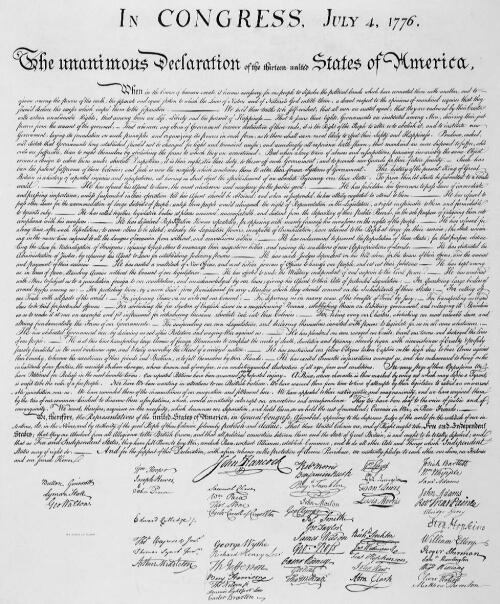
The Declaration of Independence is the first of two source documents upon which our nation was founded. This document puts forward the concepts of individual sovereignty and freedom from ruler-ship of all kinds. The Declaration of Independence was a statement adopted by the Continental Congress on July 4, 1776, which announced that the thirteen American colonies, then at war with Great Britain, regarded themselves as independent states, and no longer a part of the British Empire. John Adams put forth a resolution earlier in the year which made a formal declaration inevitable. A committee was assembled to draft the formal declaration, to be ready when congress voted on independence. Adams persuaded the committee to select Thomas Jefferson to compose the original draft of the document, which congress would edit to produce the final version. The Declaration was ultimately a formal explanation of why Congress had voted on July 2 to declare independence from Great Britain, more than a year after the outbreak of the American Revolutionary War. The Independence Day of the United States of America is celebrated on July 4, the day Congress approved the wording of the Declaration.


The U.S. Constitution is the current second source document (based on the Articles of Confederation and Perpetual Union) upon which our Nation was founded. The Union is much older than the Constitution. It was formed, in fact, by the Articles of Association in 1774. It was matured and continued by the Declaration of Independence in 1776. It was further matured ... by the Articles of Confederation in 1778. And finally, in 1787, one of the declared objects for ordaining and establishing the Constitution was "to form a more perfect Union." It describes the means by which self governance functions. It can be modified based on rules within its own framework. For this reason, it is described, in an overall sense, as a living document. It is the relationship between each citizen and the source document which determines and defines each American. This singular relationship is paramount. The Constitution for the United States is the supreme law of the United States of America. The first three Articles of the Constitution establish the rules and separate powers of the three branches which when taken together form the method of governance of the the federal Republic:  a legislature, the bicameral Congress; an executive branch led by the President; and a federal judiciary headed by the Supreme Court. The last four Articles frame the principle of federalism. The Tenth Amendment confirms its federal characteristics.

The Constitution was adopted on September 17, 1787, by the Constitutional Convention in Philadelphia, Pennsylvania, and ratified by conventions in eleven states. It went into effect on March 4, 1789.


The first ten amendments are known as the Bill of Rights. The Constitution has been amended eighteen times (for a total of 28 amendments).  The current 28 Amendments are meant to modify the Constitution with concepts which allow the Constitution to be relevant to the current society within America.

Each State has its own Constutution to further define self governance in regard to any powers or rights not mandated to the federal government by the Constitution and returned to the states should they care to take either or both before the Legislature for consideration. The many states constitutions and the U.S. Constitution are the documents which comprise the states relationship within the Republic and the Republic as a whole.

The United States of America is a representative form of Democracy that is a Constitutionally bound Federal Rpeublic. Each Comonwealth, Dominion, District, and State are Constitutionally bound representative democracies. Each Natural born Citizen is a Sovereign individual by right of birth from parents who are U.S. Citizens. U.S. Citizenship is comprised of three catagories which are determined by the method under which thier citzenship was established.

Problems always arise when any citizen dose not adhere to the concepts within the framework of the U.S. Constitution.

The U.S. Constitution is not a document of social interaction or structure.

Social interactions are the folkways, mores, morals (which have or are based on higher principles), which describe behavior between two (i.e. a dyad), three (i.e. a triad) or more individuals (e.g. a social group). Social relations, derived from individual agency, form the basis of the social structure. These are best put forward or described in a community of people which is called the social structure of the society and is governed by social codes and ethics.

Social interaction is further developed with the practice of custom, manners, etiquette, courtesy, protocol, decorum etc. Among the most prominent writers on North American etiquette are Letitia Baldrige, Judith Martin, Emily Post, Elizabeth Post, Peggy Post, Gertrude Pringle, and Amy Vanderbilt.

Judith Martin states that if one wishes to become an accepted member of any society or group, one "had better learn to practice its etiquette." Early North American etiquette books claimed that the manners and customs of the "Best Society" could be imitated by all, although some authors lamented that the lower classes, meaning those "whose experience in life has been a hardening process," in fact treated the rules of etiquette with "contempt and ... a sneer." Current etiquette books do not employ the concept of "best society," but rather define etiquette as a set of guidelines that "help steer our behavior as we move through our daily routines" and that can help deal with "the pressures of modern life [which] make it all the more difficult to stay civil." This change is reflected in the content of etiquette books; etiquette books published in the early 20th century contained detailed advice on the treatment of servants, the conducting of formal dinner parties, and the behavior of a debutante;  more modern books are likely to emphasize the importance of respecting people of all classes, races, and ethnic backgrounds. Some books make a further distinction between etiquette and manners:  Etiquette is protocol, rules of behavior that you memorize and that rarely bend to encompass individual concerns and needs. Manners embrace socially acceptable behavior, of course, but also much more than that. They are an expression of how you treat others when you care about them, their self-esteem, and their feelings. Etiquette writers assert that etiquette rules, rather than being stuffy or classist, serve to make life more pleasant. Though etiquette rules may seem arbitrary at times and in various situations, these are the very situations in which a common set of accepted customs can help to eliminate awkwardness. While etiquette is often a means to make others feel comfortable, it is also the case that etiquette can serve to eliminate inappropriate behaviors in others by increasing discomfort.

The beliefs and faiths within a society are religiously or philosophically based. These religiously based concepts are between oneself and the Great Creator of all. The philosophically based concepts, like Confucianism (which is a Chinese ethical and philosophical system) are more practically based on various traditional principles and customs.