Most people who are citizens will answer "Yes!" Citizenship alone does not make you an American. No, being American is not the ability to vote or wave the flag and sing the national anthem.
The peoples who came to America did so for freedom. Freedom to worship as they believed, freedom to work and keep the fruits of their labors, free to defend themselves from criminals.
You are an American if you refuse to obey ANY law that is unjust, because being an American is a way of life, ii is about principles and not ideology. It is about ethics and morals, regardless of where you get them. It is about the liberty to live as you feel is best for you so long as you honor and respect that same right of everyone else.
The People of the colonies chose members of their communities to represent them, and they met and formed rules of association with each other, rules or laws that provided mutual respect for liberty and rights. They formed a confederation among themselves and established a system of governance in which they could live in peace and prosperity. They committed themselves to rules of order, and when someone's life or property was endangered or taken from them, they established laws to provide justice to the victim(s) and their dependents or survivors.
Justice. That is the purpose of law. Being a 'law-abiding citizen' does not make you an American. Being American is exceptionalism because unlike every nation before it and since, the constitutionally limited republican representative system of governance, was truly a form of self-governance. The 'government' in that sense was a body politic that was a representation of the will of the People. It was not an entity of its own nor did it hold any power over its People. After all, the People created that government and gave it duties and responsibilities, while explicitly prohibiting that government from infringing on the liberty and the rights of the people.
It was by definition a form of anarchy, that is anti- monarchy, or anti- oligarchy. It was against any form of government that ruled by force and suppression of free will. And yet it did have rules and hence laws. Laws to provide justice for those accused and convicted of crimes against the People.
We now are faced with the cold, hard facts that we no longer have a constitutional republic. That was taken from the People by treasonous acts of then President Abraham Lincoln and Congress in 1871. The former made all citizens insurgents and enemies of the government, and the latter when Congress unlawfully created a government for the District of Columbia and created a corporation which would then replace the People's constitutional republic with a corporate government, which represents the financial interests of the corporation and not the People.
The Esteemed Readers of the Fix America blog and its Facebook page will know that we are in grave danger and it will only result in our nation falling if we don't act now.
Reference Links:
Articles of Association
When Law is Crime
Frédéric Bastiat: The Law
Restore America to the Constitutional federal republic representing the will of We the People!
Pages
By The People
There are fundamental flaws in how American government operates today,
contrary to the Constitution and the vision of a representative republican form of governance.
I intend doing something about it: by educating and informing others who
are not even aware of the dangers.
Showing posts with label anarchy. Show all posts
Saturday, June 14, 2014
Sunday, January 19, 2014
From Anarchy to Slavery
To
most people today anarchy is synonymous with chaos, which is the
complete disregard for law and order. Most of what we call anarchy
today is not what our founders had in mind.
To
them anarchy would have been used in contrast to monarchy, or in
other words self-rule versus being ruled over. The founders idea of
anarchy was self-governance (the ability to govern your own life).
It was
also evident to them that the People needed to maintain control of
the election process and that is why they left it up to the the
People. But when the political parties formed the population lost a
small amount of control of the voting process. By infiltrating the
State governments with political party activists, who introduced
party agenda legislation that took control of the election process
from the People and gave control to the States, which in effect gave
the parties control of the State governments and the election
process, and therefore the Federal Government.
When
you had people who were levied with unjust tariffs and/or taxes, and
British soldiers who subjected the people to unjust searches and
seizures of personal property (our Fourth Amendment rights), they had the absolute right to
exercise civil disobedience (our First Amendment rights) against those who imposed such actions
upon them. We have those rights now.
For
more on civil disobedience see:
http://www.civilliberties.org/sum98role.html
“Throughout
the history of the U.S., civil disobedience has played a significant
role in many of the social reforms that we all take for granted
today. Some of the most well known of these are:
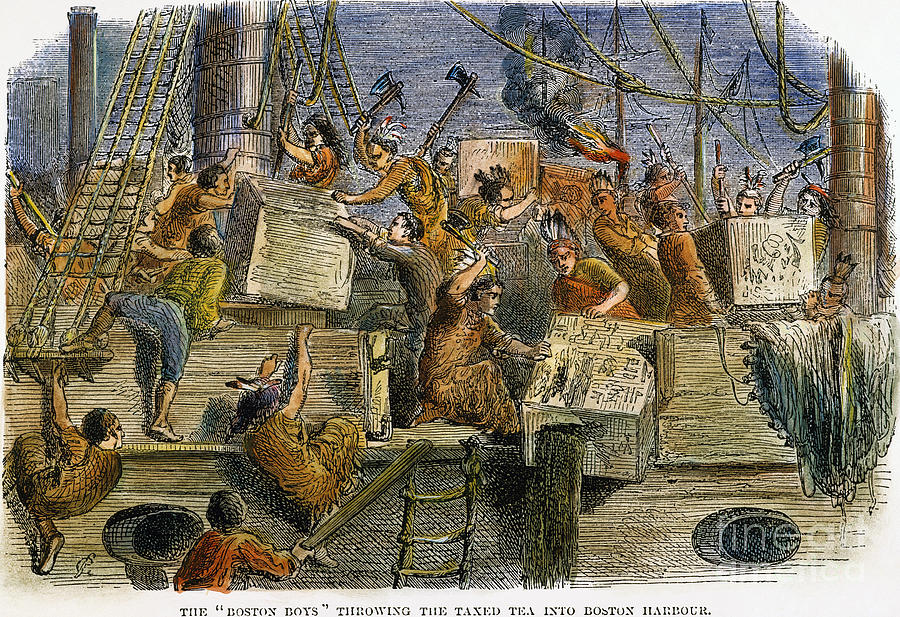
1) The Boston Tea Party -- citizens of the colony of Massachusetts trespassed on a British ship and threw its cargo (tea from England) overboard, rather than be forced to pay taxes without representation to Britain. This was one of the many acts of civil disobedience leading to the War for Independence, establishing the United States of America as a sovereign state.
2) Anti-war movements have been a part of U.S. history since Thoreau went to jail for refusing to participate in the U.S. war against Mexico in 1849. More recent examples were the nationwide protests against the war in Viet Nam, U.S. involvement in Nicaragua and Central America, and the Gulf War. Actions have included refusal to pay for war, refusal to enlist in the military, occupation of draft centers, sit-ins, blockades, peace camps, and refusal to allow military recruiters on high school and college campuses.
3) The Women's Suffrage Movement lasted from 1848 until 1920, when thousands of courageous women marched in the streets, endured hunger strikes, and submitted to arrest and jail in order to gain the right to vote.
4) Abolition of slavery -- including Harriet Tubman's underground railway, giving sanctuary, and other actions which helped to end slavery.
5) The introduction of labor laws and unions. Sit-down strikes organized by the IWW, and CIO free speech confrontations led to the eradication of child labor and improved working conditions, established the 40-hour work week and improved job security and benefits.
6) The Civil Rights Movement, led by Martin Luther King, Jr. and others, included sit-ins and illegal marches which weakened segregation in the south.
7) The Anti-Nuclear Movement, stimulated by people like Karen Silkwood and the Three Mile Island nuclear power accident, organized citizens throughout the country into direct action affinity groups, with consensus decision making and Gandhian nonviolence as its core. Massive acts of civil disobedience took place at nuclear power facilities across the country, followed by worldwide protests against first-strike nuclear weapons, occupying military bases, maintaining peace camps, interfering with manufacture and transport of nuclear bombs and devices, marching, sitting in, blockading and otherwise disrupting business as usual at nuclear sites.
8) Environmental and forest demonstrations, with acts of civil disobedience such as sit-ins, blockades, tree sits and forest occupations, have emerged in the last decade, prompted by the continuing mass clear cuts and destruction of the forest ecosystem and widespread environmental consequences.
In all of these struggles, citizens had reached the conclusion that the legal means for addressing their concerns had not worked. They had tried petitioning, lobbying, writing letters, going to court, voting for candidates that represented their interests, legal protest, and still their views were ignored.
In each of these movements, the protesters were compelled by deep moral convictions. Their distress was strong enough to motivate them to go against the grain, to sacrifice personal comfort, to face unknown danger, to give up their freedom and risk going to jail. Their love of truth and justice drove them to action. Many, but not all, of those committing civil disobedience in the last two decades have been trained in Gandhian nonviolence philosophy and tactics.
Non-Cooperation is used by some protesters during civil disobedience actions. Non-cooperation may include going limp, refusal to give information at booking, fasting and refusal to participate in court proceedings.”
1) The Boston Tea Party -- citizens of the colony of Massachusetts trespassed on a British ship and threw its cargo (tea from England) overboard, rather than be forced to pay taxes without representation to Britain. This was one of the many acts of civil disobedience leading to the War for Independence, establishing the United States of America as a sovereign state.
2) Anti-war movements have been a part of U.S. history since Thoreau went to jail for refusing to participate in the U.S. war against Mexico in 1849. More recent examples were the nationwide protests against the war in Viet Nam, U.S. involvement in Nicaragua and Central America, and the Gulf War. Actions have included refusal to pay for war, refusal to enlist in the military, occupation of draft centers, sit-ins, blockades, peace camps, and refusal to allow military recruiters on high school and college campuses.
3) The Women's Suffrage Movement lasted from 1848 until 1920, when thousands of courageous women marched in the streets, endured hunger strikes, and submitted to arrest and jail in order to gain the right to vote.
4) Abolition of slavery -- including Harriet Tubman's underground railway, giving sanctuary, and other actions which helped to end slavery.
5) The introduction of labor laws and unions. Sit-down strikes organized by the IWW, and CIO free speech confrontations led to the eradication of child labor and improved working conditions, established the 40-hour work week and improved job security and benefits.
6) The Civil Rights Movement, led by Martin Luther King, Jr. and others, included sit-ins and illegal marches which weakened segregation in the south.
7) The Anti-Nuclear Movement, stimulated by people like Karen Silkwood and the Three Mile Island nuclear power accident, organized citizens throughout the country into direct action affinity groups, with consensus decision making and Gandhian nonviolence as its core. Massive acts of civil disobedience took place at nuclear power facilities across the country, followed by worldwide protests against first-strike nuclear weapons, occupying military bases, maintaining peace camps, interfering with manufacture and transport of nuclear bombs and devices, marching, sitting in, blockading and otherwise disrupting business as usual at nuclear sites.
8) Environmental and forest demonstrations, with acts of civil disobedience such as sit-ins, blockades, tree sits and forest occupations, have emerged in the last decade, prompted by the continuing mass clear cuts and destruction of the forest ecosystem and widespread environmental consequences.
In all of these struggles, citizens had reached the conclusion that the legal means for addressing their concerns had not worked. They had tried petitioning, lobbying, writing letters, going to court, voting for candidates that represented their interests, legal protest, and still their views were ignored.
In each of these movements, the protesters were compelled by deep moral convictions. Their distress was strong enough to motivate them to go against the grain, to sacrifice personal comfort, to face unknown danger, to give up their freedom and risk going to jail. Their love of truth and justice drove them to action. Many, but not all, of those committing civil disobedience in the last two decades have been trained in Gandhian nonviolence philosophy and tactics.
Non-Cooperation is used by some protesters during civil disobedience actions. Non-cooperation may include going limp, refusal to give information at booking, fasting and refusal to participate in court proceedings.”
Please
note that 'illegal street demonstrations or protests' are those that
interfere with normal civil activities. Gathering peacefully, with
respect to the civil liberties of the public, is not an illegal
activity according to the Constitution and the natural rights of
humanity.
The
current federal government tyranny is far more pervasive than the
Crown was in the 18th Century. Today with real-time data
acquisition and analysis, and with direct access to your financial
accounts and transactions, the loss of privacy in our personal
affairs by government, far exceeds what our founders were willing to
endure before they said, “Enough!”
U.S. citizens who relinquish their freedoms little by little become, step by step, slaves to the very government created to protect their freedoms. At
what point will U. S. Citizens say, “Enough!”?
Subscribe to:
Posts (Atom)